
AI research product
rivalscope
From scattered signals to decisions with evidence.
- Context
- AI competitive intelligence tool
- Role
- Product design & independent development
- Year
- 2026–present
- Status
- Independent build · Ongoing
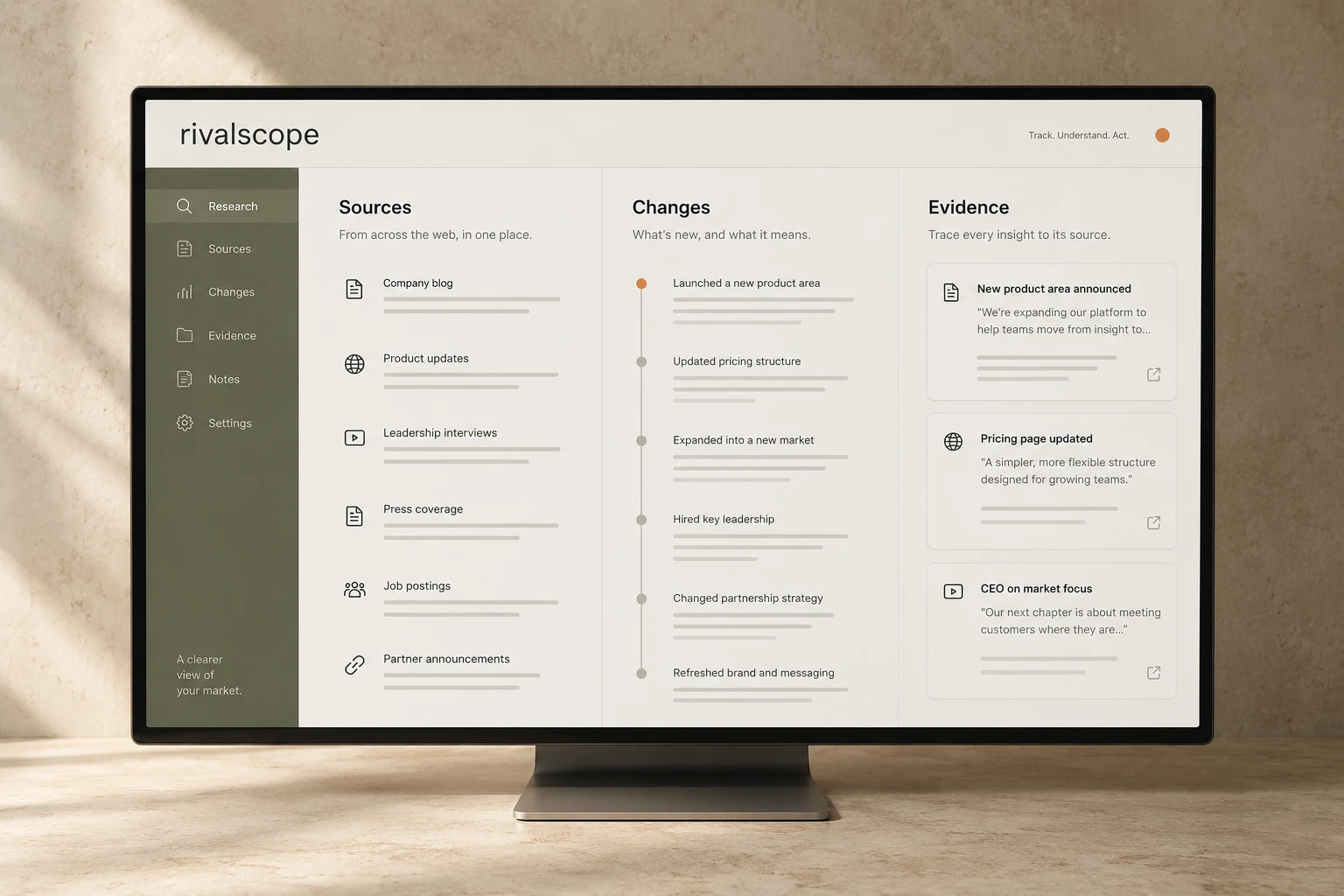
01The question
The question behind the work.
How might a competitive research workflow keep its sources visible and its conclusions useful?
02The experience
From a question to evidence.
A schematic of the experience, from the first input to what happens next.
- 01
Define the question
Set the scope and decide what to watch.
- 02
Gather & verify
Retrieve sources, check freshness and flag conflicts.
- 03
Compare & interpret
Bring changes and supporting evidence together.
- 04
Report & revisit
Export findings and return to what changes.
03My contribution
Make conclusions traceable.
I designed the product around the research process, from defining what to watch to comparing what changed. The aim was a working tool whose output could be checked, not just read.
- Mapped planning, retrieval, deduplication, analysis, and reporting into an end-to-end FastAPI and React application.
- Added source grading, freshness checks, conflict flags, citation tracing, and an explicit ‘insufficient information’ state.
- Supported scoring, SWOT, timelines, export to PDF, Word and Markdown, and scheduled follow-up summaries.
04What changed
Better inputs. More useful research.
Approximately, in one multilingual extraction test case. Not an overall product benchmark.
A multilingual website extraction fix increased usable body text by about 3.4× in one test case. It was a concrete reminder that research quality depends on the unglamorous retrieval layer.
View source on GitHub